Monday, December 7, 2020

How to Find Your Holiday Happy Place


Image by Marcos Garzo from Pixabay

The holidays are a stressful time in a normal year, but this year hasn't been exactly normal. My family had to cancel our yearly trip to visit family and friends in Hawaii, we spent Thanksgiving jumping from Zoom meeting to Zoom meeting, and we couldn't have dinner at the table because that was my new office. When expected routines get tossed out the window, it can be a real panic moment trying to find a way back to normalcy. 

Saturday, October 10, 2020

Giving my Novel Some Much-Deserved Love

reading a book
Image by fotografierende from Pixabay

Since this pandemic started, I’ve been staying mostly at home to minimize the risk of someone in the household getting sick. Which means I’ve gotten to catch up on some things, like decluttering the house, doing DIY projects, and reading.

I started reading the ebooks and paperbacks I'd purchased but didn’t get to yet. But one book sitting on my shelf that I hadn't read yet was my own book, Circles, that I published back in 2012. I decided to reacquaint myself with the novel that I spent a better part of a year writing.

I sat myself down on the couch and started reading. I read that book all day. When I turned the last page, I took a breath and thought, “Wow, this is a GOOD story!” 

Of course, it was a good story for me because, well, I wrote it – I won't deny that I'm biased here.

I realized that when I published my novel, I didn't give it the love it deserved. While I don't have trouble selling other people's brands, I felt uncomfortable selling my own book. So after my first announcement to social media that I had published a novel, a few book talks, and a couple of gentle reminders that I would have really loved some reviews, I stopped trying. 

But reading Circles again, I realized I sold my story short. My book deserved more pitching than I gave. So, I’m going to ask my novel for forgiveness: I’m going to tell everyone who will listen to read this amazing urban fantasy adventure. Yeah, ok, I admit there might be a typo somewhere in the book, and I managed to repeat a phrase at one point. But my story made me cry. Twice. And I wrote it – I knew what was coming!

If you or someone you know is a reader who enjoys fantastic adventures with supernatural characters that happen in our everyday world, Circles is a must-read. And to prove it, for the next 5 days I’m giving away a free copy of Circles this week only so I can prove to you just how good my story is. If urban fantasy is your genre, or extraordinary adventure is your thing, click this link to get a free copy of Circles.

What’s the catch? I am asking for your email so that I may do two things: 1 – tell you “I told you so” when you discover how awesome my novel was, and even if you read it and decided it wasn’t as awesome as I said it was, hey – it was free! And 2 – to ask you to give your honest review of my novel (even if you hated it), either on GoodReads, Amazon, Apple Books, or other platform you might frequent (Barnes & Noble, Scribd, etc.). You will also be added to my monthly newsletter, however, once you receive the first one please feel free to unsubscribe if you would rather not hear about any further awesomeness from me.

I am convinced that my story is worth sharing and deserves a place on your physical or digital bookshelf. So get your free ebook copy now before the offer goes away in five days!

Thursday, March 1, 2018

Communication and Teaching: Dealing with Challenges


You've prepared for your assignment as best you could and piled your bag of tricks full of useful stuff to help keep students on track. You've utilized every method possible to help students stay focused or return to the task at hand. But you are still experiencing a few hiccups with a student or two that is making class time distracting.

Wednesday, January 3, 2018

Communication and Teaching: In the Classroom

So you made it to your assignment early and you had enough time to get to know your surroundings. You got this, right? Well, yes you do…until you don’t. Which means once class has started, what are you going to do to keep students engaged and cooperative?

Friday, November 10, 2017

Communication and Teaching: Arriving Prepared

In an earlier post, I discussed how a substitute’s day isn’t always “typical.” However, arriving early and being prepared for your assignment will help you have as typical a day as possible. Here are a few tips for arriving early and what to bring with you to prepare yourself for the day.

Friday, October 27, 2017

Communication and Teaching: A Substitute's Typical Day

So what is a substitute’s typical day like? The answer is simple: there isn’t one. A day may start like this. You wake up and get a call from the sub system or directly from a school. You accept the assignment, get ready for your day, and show up to your assigned classroom. That is about where the “typical” day ends.

Wednesday, September 27, 2017

Communication and Teaching: Why be a Substitute Teacher?

When students first discover there is a sub in their classroom, one of two reactions occur: “Oh, no, a substitute,” or “Oh yeah, a substitute!” Yet both reactions usually point to the same student expectation – the class is going to be…different.

Thursday, February 2, 2017

Communication and Meaning: Not All Words Are Bad

This is a ninja (clipartion.com)
I really enjoy substitute teaching. Even when I am in a "difficult" class I have fun. Perhaps it is because I have a little bit of evil in me and relish in the challenge of an upstart student or two. I also enjoy not having to deal with school politics. I don't plan on being in one place long enough to get sucked in to any drama.

Until one day I inadvertently did, and it had to do with a word. I was sitting in the staff lounge and I overheard a teacher talking to the other teachers in the room about a memo of some sort that said teachers and students were no longer allowed to say the word...

Friday, October 14, 2016

Communication and Kendo: Part 3

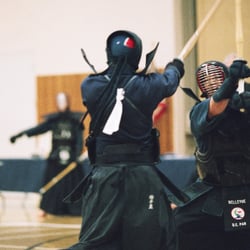
Here is the last post, unfashionably late, in my "Communication and Kendo" series. I tied communication to the art of kendo in Part 1 by talking about kendo and self-improvement. Then I introduced the idea of "Ki Ken Tai Ichi" as the second point that brings kendo and communication together. Now I want to tie in the final point of kendo - respect yourself and others. Showing respect equates to understanding who we are in relation to others.

Photo taken by David P.
Kendo is a difficult martial art to understand because it doesn't teach you useful ways to defend yourself, unless you plan to carry your bamboo sword everywhere with you. Unlike hand-to-hand martial arts such as karate or aikido, kendo keeps you at a distance from your opponent, so while the goal is to hit first (and hit correctly) you do not make any contact with your opponent except with a sword. So what's the point?

Tuesday, February 2, 2016

Communication and Appreciating Culture

I have unfortunately neglected writing my blog posts, and the main reason is I've been busy writing for Mapquest's new travel site, Parachute. My secondary reason is I contracted a mean case of the lazies while on Christmas vacation and now I need to kick it into overdrive to get back on track with my writing.

I did want to talk about my last article that I wrote for Parachute, because it directly relates to my current work in progress. While vacationing on Maui, almost every day I passed by the Pu'unene Mill - the last operating sugar mill in the islands. I would have a passing thought, "Oh, that's right. I need to set up an appointment to tour the mill for research." Then the thought would pass with "Next time," and I would move on to other vacation-related thoughts. Like the beach.

Friday, November 20, 2015

Star Wars: The Reader Awakens

Storm Trooper BobbleheadThis is going to be a short post, as I am in between writing projects that I have been updating on my Reviews and Articles page, but I've been neglecting my blog and I apologize to my readers profusely!

My son is a huge Star Wars fan. In fact I'm embarrassed to say he may very well be a bigger fan than I am. He has watched the entire saga more than I have fingers, and in particular has rewatched Episode II more than that. But I'm okay with this, because his love for all things Star Wars includes books.

He devours books on Star Wars, mostly the non-fiction works, but he will request (quite forcefully) for fiction like the Origami Yoda and Jedi Academy series. This is from a kid who not even a full year ago would break down in fits when told to read for just twenty minutes. He hated to read. It wasn't that he had trouble reading, he just didn't like it. No genre, topic or theme would get him at least interested enough to pick up a book on his own.

Now, he can't put a book down. And yes, he actively searches out Star Wars books, but he will also read other books as well - books he chooses himself. He is currently reading a book first published in 1893, Beautiful Joe, about a dog who has had a hard life. The story has nothing to do with Star Wars, space battles or aliens, but my child will choose a time to sit quietly and read about this dog. And I know I can thank Star Wars for it.

I've always known, and have always said, that once your child finds something that unlocks his or her interest in reading, all doors open. For my child, it was Star Wars. For your child, it might be Goosebumps or The Maze Runner. Whatever it is, whether a movie, a show, or a book, take that interest and run with it.

Monday, September 28, 2015

Communication and Education: Questions to Ask Your Child's Teacher

Image copyright FreeDesignFile
It's been about a month now since my son started his new school, and I can't be happier about his experience. Our curriculum night is coming up, and I am excited to hear what his teacher has to say about learning in her classroom. I'm not worried that my kiddo isn't adjusting. He is thriving both academically and socially, and it all started with a few simple questions.

I didn't ask his teacher all of these questions, some were asked to the principal prior to enrolling him into the school, and there are a few more questions that I will ask his teacher later. But your child's teacher should be able to answer all of these questions in a way that will give you a good idea what to expect in the classroom, how your child can have a successful learning experience, and how you can supplement your child's learning at home.

Thursday, September 10, 2015

Where Short Stories Come From

Ever since my first (failed) attempt at marketing my my first novel I have tried a few other times to drum up "buzz" for my work with near-zero success. Is it because my novel was terrible? Absolutely not. I put a lot of time and effort into creating a story I loved to read, so I know there are hundreds of others who would also love my book. But you wouldn't know it by the scant reviews and bottom-of-the-barrel ranking on Amazon. So what's wrong?
So many stories to choose from

I have read more books on marketing than I would care to list, and each one tells me something different about what I could have done better. But no matter what the experts say, patience, perseverance, and purpose are not enough. In an online world infused with millions of different kinds of content that bombard us every day, my novel is just one story trying to be heard among the multitude of other stories vying for your attention.

And that set me to thinking - what if I had a bunch of shorter stories to share with readers, stories that would only take up a few minutes of their time but be entertaining enough to make readers want to try out my longer works? So I got super excited and started thinking about all the stories I could tell. Until I realized every story plot I came up with would morph into something that would take more than a few minutes to read through. As good a writer as I believed myself to be, I was not good enough to tell a short story.

I tired writing prompts, I tried poetry, I tried photo prompts, I even tried to write a 100-word story to submit to an online literary magazine. None of it was working. I couldn't get a story to fit within two 8.5x11 pages. And then one day I browsed through Facebook. A friend of mine would put funny little quotes her son would say on an e-card and post them to her page, which would make their way onto my feed. I had threatened in the past to use her great quotes in a story, but never got around to it. But on this particular day she posted a quote that inspired a humorous story about the power of imagination and friendship.

It took me a couple of weeks of on-and-off writing and editing, but I managed to get the story under 800 words. I had my own son read it and give me feedback before I finally published it on Wattpad. I've discovered that I can write stories that are both short and entertaining, and my inspiration comes from the everyday lives of people. So now I would like to ask you, my readers, to help me find inspiration for more short stories that I can share with you. If you hear a funny or odd quote, or see a picture of something interesting, message me on my Facebook account, tweet your inspiration to my Twitter handle, or just post it here in the comments section.

Sunday, June 14, 2015

Question: How do I inspire my child to write?

It starts with a simple sentence.

Some of my most enjoyable moments were teaching a five-session writing class to elementary students. This is an age where their imaginations are getting broader and more inventive. This is the best time to get them to write those wonderful thoughts down on paper. But not every child I had was very excited to write.

My very first class had nine students, one of whom did not want to be there. On his first day he was adamant that his parents signed him up for the wrong class. I assured him that he was right where he should be and that he would have a great time writing. I could tell he didn’t believe me. The first and second classes were unproductive with respect to this student. While every other student was in their second drafts, he still hadn’t created a single sentence.

And then during the third class meeting, something amazing happened. There was a break in the lesson plan and all the kids were having conversations about their stories. One child made a joke about something, and another child elaborated on it. I let the conversation continue into lesson time, because the joke had somehow morphed into a communal story, with every child adding to the plot – including my writing-resistant student. In fact, he was the most ardent adder to the story, and his fellow classmates would encourage his input by complementing his version with their own.

I finally called the class to order and had them continue working on their current drafts. I then knelt beside my reluctant student’s chair and said, “You added incredible elements to the story you were all sharing. I would love to hear the end of it.” His eyes lit up and he started to talk about his ideas, but I interrupted him. “Wait, wait, I’m going to forget this great story. I need you to write it down so that I can remember it.” And with that, he wrote his story, first draft to finished product.  And it truly was a wonderfully imaginative story with much humor and adventure.

If you have a child who absolutely hates to write, it’s because they haven’t yet found the story that demands to be remembered. And the more you push them to write, the more they may not want to do it.  So what can you do?

Let’s take this from a reluctant writer’s point of view. Writing is boring. There are so many other things he or she could be doing than sitting at a desk with a paper and a pencil. The reluctant writer has not yet discovered the meaning of writing, which is to have fun with your imagination, to go places you haven’t been. But it all starts with a simple sentence.

Be a role model. If you are a reader and a writer, then your child will be, too. Start with a sentence. Sit with him or her and write a letter to a far-off family member, write a journal entry about what you did today. Write a grocery list. Find as many excuses as you can to model writing behavior.

Encourage writing. Encourage your child to write down his thoughts whenever he has something exciting to talk about. Tell him that something so exciting should be written down so it isn’t forgotten. Start with a sentence. And then have him read what he wrote to you, even if it is only one sentence. Never mind if the grammar or spelling is not perfect. It doesn’t have to be, until he is ready to share it with a critical group (such as his class or for a writing contest). My mantra is “as long as I can read it.”  Let your child know that it’s okay to have imperfect writing. He will have time to improve on his writing as he learns to revise and edit his work. And if only he will see his work, what does it matter if he didn’t spell “especially” right.

Embrace technology. Lastly, teach your child to use a computer. When a child has lots to write about, it can be discouraging when her hand starts to hurt. Teach her to type so she can write her story using a word processing program. Teach her how to save her work, and teach her to create new drafts to edit, instead of editing her original work.

Start with a simple sentence. Your child may only want to write a sentence or two without grumbling. But as writing becomes a daily adventure rather than a chore, those sentences will come together into a story of his or her own. Be a writing role model and give encouragement any chance you get. Your child will eventually have that “aha” moment and will want to write about it.

Sunday, June 7, 2015

Question: Are YA Novels Really for Young Adults?

This is a question I am often asked by parents. Parents are becoming more aware of what is written in today's "young adult" novels, thanks in part to the sudden flurry of books-turned-movies that have graced our theaters since Twilight. They are noticing that the books aimed at teenagers appear more mature in theme than the YA fare of their youth. But is it really becoming "too adult?"

First of all, Young Adult is a designation, not a genre. It represents novels about teenaged characters undergoing a coming of age moment. Within this designation, there are different genres for young adult readers to choose from, from science fiction and fantasy to romance and historical fiction.

A Little History

Children's fiction has been around since books became widely accessible in the 1800's. Books for older children sprang up like Swiss Family Robinson(1812), Oliver Twist (1838), The Adventures of Tom Sawyer(1876), and Alice in Wonderland (1865). These and others became the literary classics of "Children's Literature" and were filled with the adventurousness of youth, but it also carried the problems children faced then: poverty, child labor, family obligations, and poor education.

In the 1950's and 60's books written for teenaged readers reflected the darker, more turbulent times. Gone were the adventures of youth, replaced by the harsh realities of an era of war, racism, and one's place in society. Created were the great but controversial works like The Outsiders (1967), Catcher in the Rye (1951), and Lord of the Flies (1954). Clearly, older teen readers were searching for something more than "children's"  literature.

Publishers began to see the opportunities available in a "Young Adult" market, and in the 1970's and 80's booksellers and libraries began creating young adult sections to easily distinguish between books meant for young children and books meant for older teens. Thus the YA designation was born. But the themes were still no less edgy than its predecessors, only different. These later decades reflected the fears of youth: pregnancy, death, and self-identity. Judy Blume's Forever (1975) and Tiger Eyes (1981), Robert Cormier's The Chocolate War (1974) andFade (1988), and Katherine Paterson's Bridge to Terebithia (1977) are a few examples.

It may seem that the content of young adult fiction has gotten heavier through the 90's and up to present day, but in truth the themes are the same. Teens moved away from the more formulaic coming-of-age novels and sought out other genres. They fell into horror with R.L. Stein and Christopher Pike, ate up stories about ghosts, vampires and werewolves with paranormal writers Neil Gaiman, David Shan, Stephanie Meyer, and Richelle Mead, and dove into dystopian worlds from Lois Lowry, Marie Lu, Suzanne Collins and Veronica Roth. These imaginary realms of monsters and mayhem opened up new ways to see sex, death, and identity.


Are YA Novels Safe for my Child to Read?

When I am asked about whether a YA novel is okay for one's son or daughter, my answer always comes with a caveat. It is a book that is marketed to teenagers, BUT (here's the caveat) you may not feel comfortable with the problems addressed in the story. Then again, let's face it – if a teenager finds a book interesting enough to want to read it, he or she is going to find a way to read it.  And perhaps these titles are a bit heavy on the sex, violence, or death, but to quote someone who posted this thought on Goodreads: "There is nothing 'safe' about reading. Reading is a dangerous, subversive activity intended to challenge authority and expand the mind."(Moonlight Reader)


It is a parent's responsibility to look out for the best interests of their children. Some parents are more open to the "dangerous and subversive," others are not. If teenagers are voracious readers, they may not even bother with the young adult section and move straight into the adult genres. I certainly did. So worrying about whether a YA novel may be to risqué might be the least of your problems.

There are acceptable limits, to be sure. For example, I know a 9-year-old that reads the Hobbit series with relish. But just because he can read and comprehend such works doesn't mean I would recommend the Game of Thrones series to him. But if a high-schooler wanted to read GoT, as a parent you could discourage it but the decision ultimately falls to your teenager.

What is most important is that parents should read what their children are reading so that there can be a meaningful discussion about the themes presented. Pay attention to YA titles, but also pay attention to what is in the pages. And above all, trust that your child will be able to interpret the themes of a book in a mature and meaningful way.

Monday, April 20, 2015

Question: How do I get my third grader to read regular books?

Image courtesy of Clipartpal.com
A while ago, a parent told me her third-grade son loved to read comic books, but she couldn't get him to read regular chapter books. She was frustrated by this and asked me for suggestions to get him interested in reading the "regular books." I asked her why she felt he needed to start reading those "regular books," and her response was, "His fluency scores are terrible and he is behind on his reading scores for his grade level."

Wednesday, April 15, 2015

Reinventing the Library Identity

Original post by Jae Holt
October 23, 2013

**This article was originally posted on the MamaManga website. The question, "if there aren't any paper books, is it still a library?" is still being answered. I wanted to reintroduce this article to readers and then revisit the question by inviting you to give me your answers. Please leave your comments below.
Carnation Library
In September of 2013 in the south end of San Antonio, Texas,a new library opened up. But it wasn't your parents' kind of library. This library, known as BiblioTech, does not have any physical copies of books. Its entire catalog is located online in the form of eBooks. The library also provided over 600 e-readers and computers for patrons to access these eBooks. Other cities and many college and university campuses were also embracing bookless libraries. And the question was asked, if there aren't any paper books, is it still a library?

Wednesday, April 1, 2015

Raising a "Normal" Child - Social and Emotional Learning

One day, while watching one of my son's soccer practices, I began to notice how the kids interacted with each other and their coach. If a conflict arose, there would be some words exchanged and maybe a few huffs and eye-rolls here and there. But whatever the problem was either got fixed, or it wasn't important enough to continue talking about. The ones that did require some intervention were brought up to the coach, who appeared to handle the disagreements appropriately and to everyone's satisfaction. The coach always maintained a very positive attitude and no one was ever singled out as "the problem." He was able to get everyone back on track.

So a question popped into my head: My son had difficulties getting along with other kids in his school, but he had no trouble working with his teammates in soccer, why was that?


Wednesday, March 11, 2015

Interview With a Character 4

Emalie Napunoa
 
Emalie with obligatory cherry blossoms
As I'm polishing up my second draft of Under a Mango Moon, I'm getting to know Kai's mother, Emalie. She doesn't get much story time for some reason, so the other day I decided to get to know her a little better. I started off by imagining what she looked like. And since my drawing skills are not the greatest, I decided to bring her to life through my just-as-meager Photoshop skills!

Once I got to see her, I knew I was ready for a conversation. So here it is!

Sunday, March 8, 2015

The Fascination With Steampunk

Automaton from Cirque du Soleil's Kurios
When I embarked on this journey to write a story about a young boy growing up in a very different historical version of Hawaii, I knew that I wanted to incorporate the imaginings of an often misunderstood genre - steampunk.

When most people hear of the term for the first time, images of Victorian garb, goggles, metal wheels and cogs, ray guns, and flying dirigibles may be the images that come to mind. But as a written genre, it can become so much more. Steampunk takes the glorious age of the Industrial Revolution - poverty, pollution, progress, and all - and asks the question, "What if it still existed?"

Jules Verne may be the earliest author to give voice to such a question with his classic 20,000 Leagues Under the Sea. His futuristic submarine and weaponry were fine examples of how far the technology of the Industrial Revolution could take humanity. Today, we have television shows that have celebrated the "Age of Steam," such as Warehouse 13 and Doctor Who. You can even find examples in movies: Wild, Wild West, The Golden Compass, or Howl's Moving Castle. Even video games have embraced elements of steampunk as with .Hack//G.U., Bio Shock, and Order: 1886.

Kurios performers atop the tent
I was fortunate enough to have the opportunity to watch Cirque du Soliel's Kurios: Cabinet of Curiosities. It was an amazing visual display of steampunk and I was happy to have seen it. The stage design was exquisitely laid out with Tesla-coil-like devices, bronze colored machines and towers, and Edison lights scattered throughout. The costuming ranged from mad-scientist lab gear to Victorian holiday travelers, to odd automatons and fish. Yes fish.

I enjoyed the show from start to finish, and reveled in being immersed in a humble scientist's steampunk dream. What if science could change the way we lived? In the scientist's dream, we would have robots that helped us, modes of transportation that would takes us anywhere we wanted to go, we would discover amazing new sea creatures, and see the possibilities our world has to offer.

I hope I can follow such an imaginative world with my own. Hawaii, as a self-governing monarchy, came to an end in 1893. But what if it hadn't? That is the question my imagination answers, while also adding "What if Hawaii embraced industry, with sugar cane being its primary driver?" These questions set the stage for my characters, giving them a home within which to roam and have an adventure. While my novel may not take you to the world of steampunk that is strictly Victorian in nature, it still embraces the idea of a cultural shift in the face of rapid progress; I want you to experience this world from a unique perspective of island life and Asian influence.